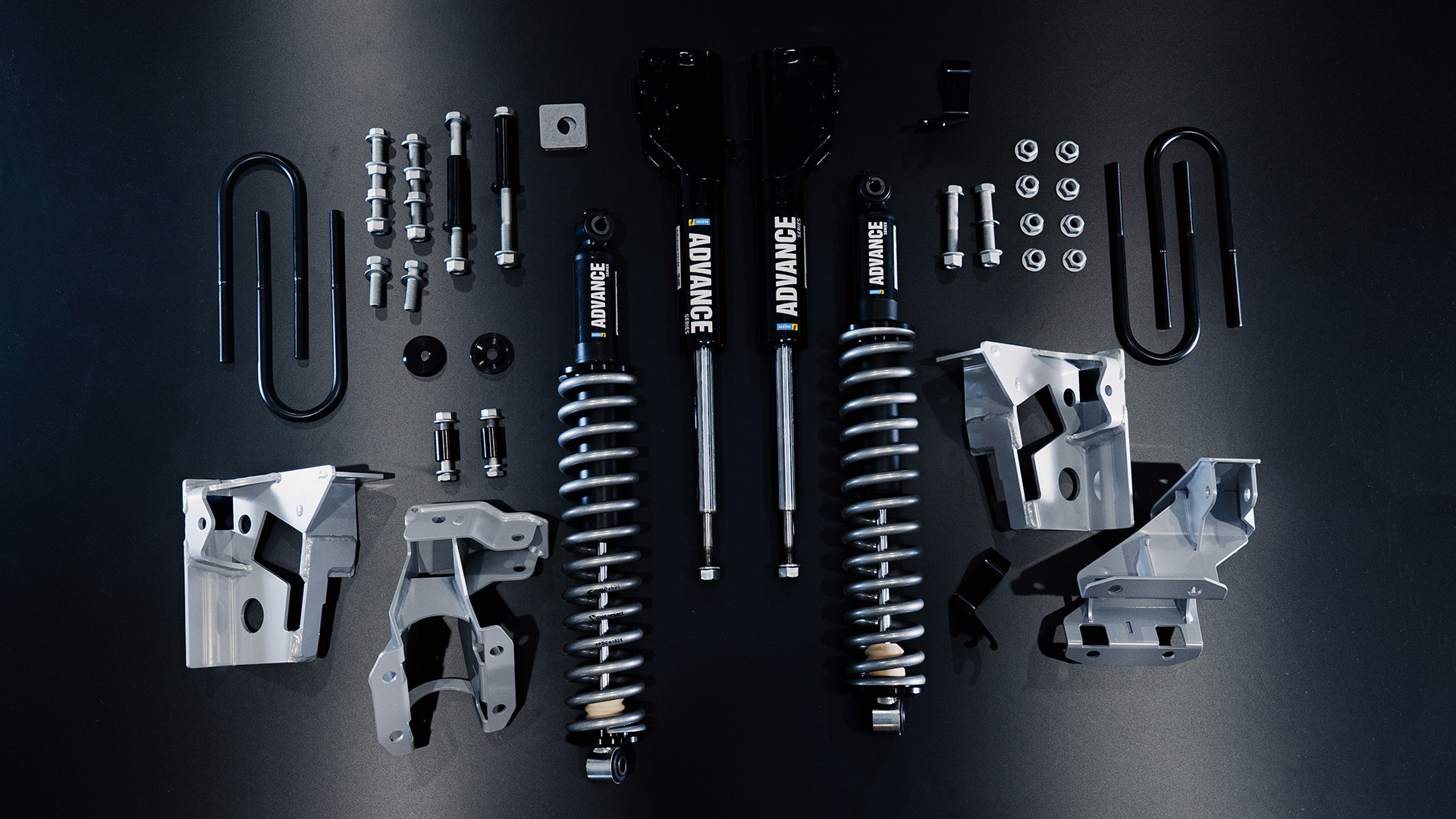
An off-road suspension transforms your campervan from a road vehicle into an off-road motorhome. More ground clearance, better control on uneven terrain and noticeably more stable handling – a professional off-road chassis fundamentally expands your travel options. If you want to travel off the beaten track, you need more than just standard equipment. This guide shows what options are available and what a high-quality off-road suspension can do.
Inhaltsverzeichnis
Why an off-road chassis makes sense for campervans
Many campervans are designed for European roads – asphalt, highways, paved pitches. But modern travel routes go further: gravel roads in Scandinavia, mountain passes in Albania, off-road routes in Portugal, long sandy tracks in Morocco. An off-road chassis ensures that you can travel where others have to turn back.
The biggest advantage is the increased ground clearance. Every centimeter of additional clearance between the vehicle’s underbody and the ground reduces the risk of the vehicle touching down. Potholes, fords, rubble or roots become much safer to drive over. The protection of the underbody, tanks and exhaust system is also significantly improved.
Off-road suspension not only increases ground clearance, but also improves driving dynamics. Modern systems offer better damper response, fewer bumps in the interior and smoother driving on corrugated roads. This not only protects occupants, but also furniture and technical installations in the campervan.
Ground clearance: the decisive factor
More ground clearance fundamentally changes the capabilities of a camper van. Many vans only offer 15 to 18 centimetres clearance from the ground as standard – sufficient for roads, but limiting off-road.
An off-road suspension typically raises the vehicle by 3 to 5 centimeters. Some air suspensions allow even more leeway. These extra centimeters may not sound like much, but they make the difference between safe passage and a damaged underbody.
Practical advantages of increased ground clearance:
- Less risk of touching down on obstacles
- Safer passage through potholes and debris
- Better protection of the underbody, tanks and exhaust system
- More relaxed driving on unpaved roads
- Access to remote pitches and nature campsites
A climb that was previously impassable suddenly becomes rideable. A stone that would have endangered the exhaust system becomes irrelevant. Ground clearance is not a detail – it decides whether you continue or turn back.
Slope angle and ramp angle: geometry decides
In addition to the ground clearance, the slope angle and ramp angle play a decisive role in off-road capability.
Front and rear slope angles: These angles describe how steeply a campervan can drive up or down without hitting the front or rear. The greater the slope angle, the steeper ramps, hills or descents can be.
Ramp angle: This angle is crucial for crests, waves and ditches – especially with longer wheelbases. A good ramp angle prevents the campervan from touching down in the middle when the front and rear wheels are at different heights.
An off-road suspension improves this angular geometry by raising the suspension height. Practical examples where this is important: Driving over rocky edges in the mountains, steep exits on mountain paths, passages with deep washouts or uneven access roads to remote campsites. A standard campervan quickly reaches its limits here – an off-road chassis pushes these limits significantly.
Increased comfort thanks to professional running gear
Many people underestimate the comfort gain of a correctly tuned off-road chassis. It’s not just about off-road capability, but also about a noticeably more pleasant ride.
High-quality off-road suspensions offer better damper response. Shocks and bumps are absorbed more effectively and the driving experience on corrugated tracks is smoother. The handling in bends is also improved – less rolling in crosswinds or when loaded, more controlled driving dynamics on changing surfaces.
Comfort is particularly important for fully equipped campervans. A quiet vehicle is easy on furniture, technology and occupants alike. Long journeys are more relaxed and fatigue is reduced. Fully equipped campervans benefit in particular from stable, comfortable running gear.
Air suspension option:
Air suspensions not only provide comfort, but also precision. The vehicle levels itself automatically, the loading height can be lowered and the ground clearance can be increased depending on the situation. The handling adapts dynamically to the terrain and load.
For many drivers, air suspensions are the biggest leap in comfort that a campervan can experience. The investment is similar to that for classic suspension lifts, but the added ride comfort is considerable – especially when frequently switching between road and off-road.
Types of off-road chassis for campervans
There are various approaches to realizing an off-road chassis. The choice depends on budget, usage profile and desired comfort level.
Lifting kits (springs + dampers): The classic, robust variant. Lift kits replace standard springs and dampers with reinforced, longer components. The vehicle gains ground clearance and stability is improved. This solution is more cost-effective than air suspensions, durable and low-maintenance. Ideal for off-road beginners and moderate off-road driving. We install lift kits from delta4x4, for example.
Air suspensions (1-, 2- or 4-channel systems): The premium solution for discerning campervan drivers. Air suspension systems enable stepless adjustment of the vehicle height, automatic leveling and maximum ride comfort. Lateral tilt and pitching movements are reduced, the driving dynamics remain safe and controlled even under high loads. An air suspension is often the best choice for long distances, frequent off-road use and heavy campervans.
4×4 + off-road chassis: The combination of all-wheel drive and off-road chassis transforms a campervan into an expedition vehicle. Maximum traction, safe driving on sand, snow and mud – real off-road passages become possible. But even a 2WD with high-quality off-road suspension can achieve an astonishing amount – much more than most people expect. We install kits from 4×4-proyect, for example.
Loading: More payload for more freedom
Many campervans drive at the limit of their permissible payload as standard. Solar system, spare wheel, additional tanks, furniture – everything weighs. Heavy off-road tires require additional reserves. A professional off-road chassis can often make it possible to increase the load through technical modifications.
Typical loads:
- From 3,300 kg to 3,500 kg
- From 3,500 kg to 3,850 kg
- From 3,850 kg to 4,250 kg (depending on model)
- From 4,100 kg to 4,500 – 4,700 kg
More payload means more safety and legal operation. For travelers with a lot of luggage or long tours, the extra load is a decisive advantage. TÜV approval is also easier if the vehicle is not permanently overloaded.
Important components for off-road campervans
An off-road chassis only develops its full effect in combination with the right components.
All-terrain tires (AT): The most essential addition. AT tires provide more grip, greater lateral stability, stronger sidewalls and better behavior in mud and gravel. Without suitable tires, even the best chassis will fall short of its potential.
Differential locks: locks direct power to where it is needed – to the wheel with grip. Differential locks are a useful addition for demanding terrain, increasing traction and safety.
Protective components: Underride protection, sill reinforcements and protective plates protect sensitive components from damage. Anyone who regularly drives off-road should not neglect these components.
Recovery equipment: Winches, recovery eyes and MaxTrax are standard equipment for demanding adventures. Even if you rarely need them, they are indispensable when you do.
Who is an off-road chassis suitable for?
An off-road chassis is worthwhile for various user groups – but not for everyone.
Expedition travelers: Anyone who regularly travels off-road will benefit massively from increased ground clearance and better off-road capability.
Overlander with comfort requirements: If you want a quieter ride, stability and safety reserves, high-quality suspension systems are the ideal solution.
Owners of heavy campervans: If you are driving at the technical limit due to the expansion, equipment and payload, you need a chassis that carries these loads safely and offers comfort at the same time.
Nature travelers: If you love remote pitches and off-grid camping, you need a vehicle that can reach these places.
VANME: High-quality campervan conversions from Hamburg
VANME is a campervan manufacturer from Hamburg. We combine clear design with craftsmanship and build interiors that feel like a real home away from home – individually planned, implemented to a high standard and designed for long journeys.
We can also advise you on technical upgrades such as off-road suspensions, suspension lifts and weight increases. Our partner workshops carry out professional suspension conversions – TÜV-compliant, precisely tuned and perfectly integrated into your overall concept.
Whether air suspension for maximum comfort, classic suspension lift for more ground clearance or complete off-road conversion – we develop solutions to suit your travel style.