


Table of contents
Retrofitting a parking heater means independence and comfort for camper van travelers. Anyone traveling in autumn, winter or spring knows that it quickly becomes uncomfortable without a heater. Modern auxiliary heaters ensure comfortable temperatures without having to run the engine. This saves fuel, protects the environment, and makes self-sufficient travel truly comfortable.
Why a parking heater makes sense in a motorhome
A parking heater heats the interior independently of the vehicle engine. The system uses the fuel tank of the base vehicle and generates heat via a burner. The warm air is distributed evenly throughout the vehicle.
The biggest advantage: you can heat without running the engine. This saves diesel or gasoline and reduces noise. Especially on parking spaces or in residential areas, this is a decisive gain in comfort. The heating also ensures comfortable temperatures at night without you having to get up all the time.
Modern systems work efficiently and consume very little fuel – typically between 0.1 and 0.3 liters per hour, depending on performance and outside temperature. Power consumption is also low at 10 to 30 watts. This makes parking heaters ideal for self-sufficient travel.
Diesel or gasoline parking heaters: Which fuel is right?
When retrofitting a parking heater, the choice of fuel takes center stage: diesel or petrol heaters. The decision depends on the base vehicle, as the heater uses the existing fuel tank.
Diesel parking heaters are the most widespread, as most motorhomes and camper vans are based on diesel vehicles. They work efficiently, reliably and are designed for continuous operation. Diesel has a higher energy density than gasoline, which results in slightly lower consumption. Typical models are Truma Combi D or Autotherm Air 2D.
Diesel parking heaters are particularly suitable for frequent travelers and winter campers. They run stably even at extreme sub-zero temperatures. Important: In winter, you should fill up with winter diesel in order to prevent the fuel line from clogging due to kerosene leakage.
Petrol parking heaters are less common, but are required for petrol-powered base vehicles. They work on the same principle as diesel heaters, but are designed to use petrol as fuel. The technology is similarly sophisticated, but the availability of models and spare parts is lower.
Petrol heaters are slightly quieter in operation than diesel models and start more quickly. Fuel consumption is slightly higher, but remains within the same range at 0.1 to 0.3 liters per hour. They are the only sensible option for owners of petrol-powered campervans.
Power and dimensioning: How much heating power does your camper need?
The required heating capacity depends on several factors: Vehicle size, insulation, usage scenario and climatic conditions.
Air heaters with an output of 2 to 2.5 kW are usually sufficient for well-insulated panel vans up to 6 meters in length. Larger vehicles or poorly insulated extensions require 4 to 5 kW. If you are traveling in the high mountains or in Scandinavian winters, you should choose a more generously dimensioned heater.
An oversized system switches on and off more frequently, which increases wear and tear. A heating system that is too weak, on the other hand, runs continuously at full load without heating the interior sufficiently. Expert advice helps to determine the right output.
Fitting and installation: What to consider when retrofitting
Retrofitting a parking heater requires manual skill and technical understanding. If you are unsure, you should leave the installation to a specialist workshop.
Installation involves several steps: First, a suitable installation location is chosen – usually under the vehicle or in the interior in a cabinet. The heater must be protected from splashing water and well ventilated.
The fuel line, exhaust pipe and air supply are then connected. The fuel line taps into the tank, the exhaust pipe carries combustion gases to the outside. With air heaters, additional air ducts are laid to distribute the heat evenly.
The electrical wiring connects the heating, control unit and vehicle battery. Modern systems can be controlled via timer or app. Neat cable routing and proper fuse protection are essential.
Installation is followed by commissioning: the system is vented, checked for leaks and function tested. The installation is only complete when everything is running smoothly.
Costs: How much does it cost to retrofit a parking heater?
The cost of a parking heater is made up of the purchase, installation and any additional components.
Air heaters are cheaper to buy. Entry-level models start at around 800 to 1,000 euros, high-quality systems cost between 1,500 and 3,500 euros. Water heaters are priced higher: from 1,500 euros for simple models, up to 4,000 euros for high-performance systems.
The installation costs vary depending on the vehicle type and complexity. Specialist garages typically charge 1,000 to 2,500 euros for the installation of an air heater. Water heaters require more effort and the installation costs are correspondingly higher.
Additional components such as timers, remote controls or app control increase the price by 100 to 300 euros. Air distribution systems, hot water boilers or additional radiators can incur further costs.
All in all, you should expect to pay between 1,500 and 5,500 euros for a professionally installed air heater. Water heaters range from 2,500 to 6,000 euros – depending on the installation and desired comfort level.
Operation and consumption: How efficient are parking heaters?
Operating a parking heater consumes fuel and electricity. Both factors are manageable if the system is correctly dimensioned.
Modern air heaters consume an average of 0.1 to 0.25 liters of diesel per hour. With a running time of 8 hours per night, that is 0.8 to 2 liters. The power consumption is 10 to 30 watts – negligible compared to other consumers such as refrigerators or lights.
Water heaters consume slightly more: 0.2 to 0.4 liters of fuel per hour, as they also produce hot water. However, there is no need for a separate hot water boiler, which puts the total consumption into perspective.
The insulation of the vehicle is crucial for efficiency. Well-insulated extensions retain heat for longer and reduce the heating time. Programming also plays a role: lowering the temperature at night saves fuel without getting uncomfortably cold.
VANME: Retrofit parking heater professionally
VANME is a campervan manufacturer from Hamburg. We combine clear design with craftsmanship and build interiors that feel like a real home away from home – individually planned, implemented to a high standard and designed for long journeys.
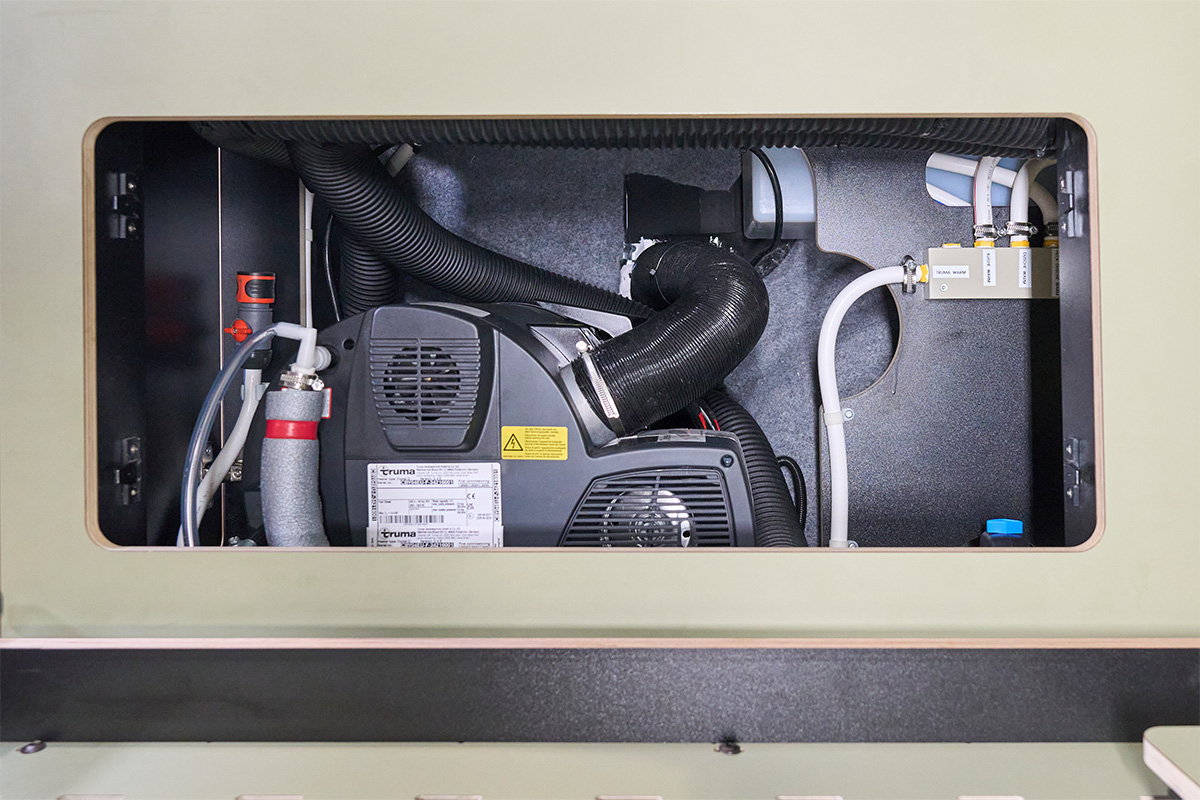
When retrofitting parking heaters, we rely on tried-and-tested systems from Truma and Autotherm. The installation is carried out professionally, cleanly and with a view to the overall design of the vehicle. We install air ducts invisibly and integrate controls harmoniously into the interior.
We advise you on the choice of system, dimension the heater to suit your vehicle and take care of the complete installation, including commissioning. The result: a reliable, efficient heating system that will accompany you for many years.
Maintenance and care: ensuring longevity
Parking heaters are low-maintenance, but require regular attention. An annual inspection extends the service life and prevents breakdowns.
During maintenance, the combustion chamber, exhaust pipe and air filter are cleaned. Fuel filters are replaced and electrical connections are checked. The function of the controls and sensors is also checked.
You should run the heater regularly between inspections – even in summer. A monthly test run of 10 to 15 minutes prevents seals from drying out or deposits from forming.
Pay attention to unusual noises, smells or error messages. Modern heaters have diagnostic functions that indicate problems at an early stage. If you notice any abnormalities, you should visit a specialist workshop.